Vainqueur's Defeat of Maure
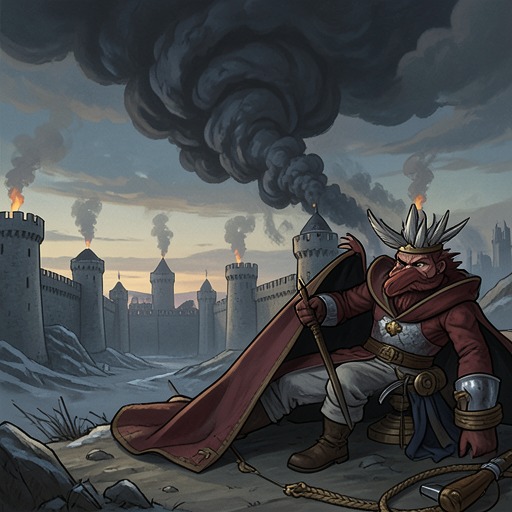
Vainqueur the DragonVainqueur's Defeat of Maure is the campaign's decisive turning point: Vainqueur Knightsbane kills Brandon Maure, saves the great hoard from the demon king, and converts battlefield triumph into recognized sovereignty over Ishfania. What begins as a monstrous assault on a fortified enemy becomes a victory with consequences far beyond the duel itself, reshaping the political map and securing Vainqueur's position as an emperor whose power can no longer be treated as a local curiosity.
Causes and Background
The conflict grows out of the struggle over the dragon's way of life and the protection of Vainqueur's hoard. Before the final confrontation, Vainqueur understands the approaching battle as the culmination of his cause: he listens to the drums of war and identifies it as the final battle for the dragon's way of life. The objective is therefore both material and ideological. Maure threatens the hoard, but defeating him also means defending the community, customs, and political identity that have formed around Vainqueur's rule.
The campaign is fought against a powerful, organized enemy rather than an isolated monster. Maure appears in demonic moth form, armed with a blade and supported by a flock of demons. He confronts Vainqueur from the Iron Eagle, declaring that the dragon has slighted him long enough and that Vainqueur will die. Vainqueur answers by accepting the immediate contest, and the two engage in battle around the flying fortress. The encounter thus combines personal vendetta, aerial warfare, and the wider military conflict between Maure's forces and Vainqueur's coalition.
Course of the Campaign
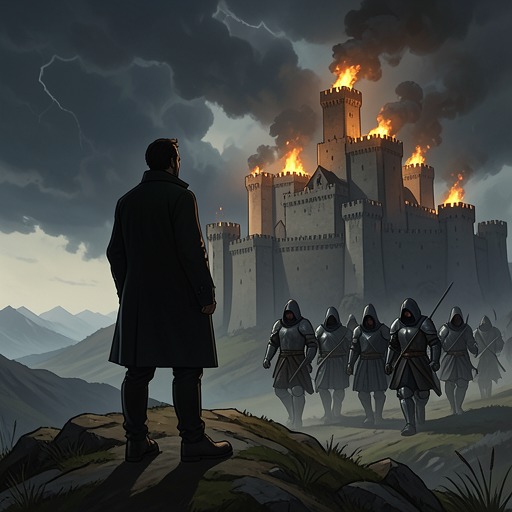
Vainqueur's forces attack Maure's castle through coordinated cooperation among different kinds of minions. Led by the Kobold Rangers, the heroic minion armies use mobile wooden bridges to reach the castle while fighting imps and undead. Kobolds, werewolves, and undead minions fight together as one force under Vainqueur's supervision. Their cooperation is significant because the victory is not presented as the accomplishment of a solitary dragon alone; it is the result of a command structure capable of turning varied monster populations into an army.
The castle itself is defended by dragon statues that fire rays of light at Vainqueur. He circles the fortress, bombards its defenders with his breath, and avoids the statues' attacks while taking the opportunity to display his grandeur. The scene joins practical combat with Vainqueur's characteristic theatricality: he is fighting for survival and the hoard, but he is also performing imperial magnificence in the middle of the battle.
The final confrontation extends that aerial struggle. Brandon Maure, transformed into his demonic moth form, flies out of the Iron Eagle with other demons and openly challenges Vainqueur. Vainqueur engages the flying fortress, and the battle ultimately leaves Maure dead and his army broken. Later reports describe the result plainly: Maure's army has been left in shambles, while Vainqueur has claimed Ishfania. The defeat is therefore both the destruction of the enemy commander and the collapse of the military power that sustained his state.
Military Consequences
The victory changes the balance of the war at Murmurin. When Victor Dalton reaches Murmurin, the village is under siege by Ishfanian scouts, with the main army approaching behind them. The V&V Adventurer Company has armed everyone, and the citizens have built barricades south of the village. Allison and Rolo reinforce the defenses with a dense barrier of thorns and blackberries, using vegetation to delay the invaders.
Victor recognizes that the defenders cannot win a prolonged battle against overwhelming numbers. Their only viable plan is to delay the Ishfanian army until Vainqueur destroys the flying fortress and causes the enemy's rout. His speech to the minions turns the battle into a defense of the hoard in its expanded sense: the hoard includes Vainqueur's gold, but also the people, animals, and shared resources threatened by the invaders. By invoking the earlier War of the Hoard and proclaiming the unity of V&V, Victor transforms fear into organized resistance. Vainqueur's defeat of Maure is consequently the action that makes the defense of Murmurin possible; once the fortress falls, the larger army loses the force needed to continue the assault.
The victory also has a direct effect on Vainqueur's status within the Class System. After striking the Iron Eagle, he regains his Emperor title with style, and his Perks are restored. This restoration matters because the system had previously limited his advancement: at level thirty, he had reached the class ceiling and could gain no further levels without using a Crest, although special deeds could still grant Perks. The defeat of Maure therefore functions simultaneously as a military achievement and as a formal revalidation of imperial identity.
Political Settlement
Maure's death leaves Ishfania without its army or its former ruler. King Roland explains that with the army destroyed and Maure dead, Ishfania is gone as a nation, even though the demon-infested desert still contains enough resources to attract competing powers such as the Eversun Empire, Barin, and Prydain. The danger is not simply a defeated enemy; it is the vacuum created by defeat. Roland fears that rival claims could produce another Century War.
The proposed solution is a treaty. Gardemagne recognizes Vainqueur as Emperor of Ishfania, treats the territory as an official adventurer state, and allows him to rule it as he wishes while retaining the benefits of the Adventurer Guild. In return, Vainqueur vows that the two countries will never take arms against each other and will fight together against outside threats. The settlement converts conquest into a mutual protection pact and gives diplomatic form to the power Vainqueur has acquired through victory.
Vainqueur immediately sees the additional advantage: recognition protects his access to the Emperor class. His response reveals how closely political legitimacy and system mechanics are joined in his world. The treaty is not merely a diplomatic reward for service to Gardemagne; it is also a safeguard against the Class System again denying the title that defines his authority. Roland, meanwhile, presents the arrangement as a practical means of preventing a new war and preserving relations with the new Ishfanian government.
Narrative Significance
The defeat completes a recurring movement from combat to administration. Vainqueur fights to protect his hoard, commands a mixed monster army, destroys Maure's fortress, and then receives recognition as a territorial ruler. The personal language of insult and revenge gives way to treaties, borders, resources, and mutual defense. The transformation is not a departure from his motives so much as their enlargement: what Vainqueur calls his hoard now includes an army, a village, a territory, and the political arrangements required to keep them.
The aftermath also confirms that the victory changes other characters' choices. Lucie Lavere reports that Vainqueur has claimed Ishfania with Gardemagne's support and that most of his guests have followed his example by deciding to become adventurers. Her report presents the defeat from outside the victorious coalition, emphasizing how quickly Maure's collapse has spread through the political and social order. Vainqueur's victory does not end the story's conflicts, but it establishes the new reality against which later powers must act: Maure is dead, Ishfania is claimed, and Vainqueur's monster civilization has become a recognized force.